


What Rising Inflation Means for Property Buyers and Investors in 2026

Picture of PropertySage

PropertySage

TRUSTED PROPERTY MANAGEMENT

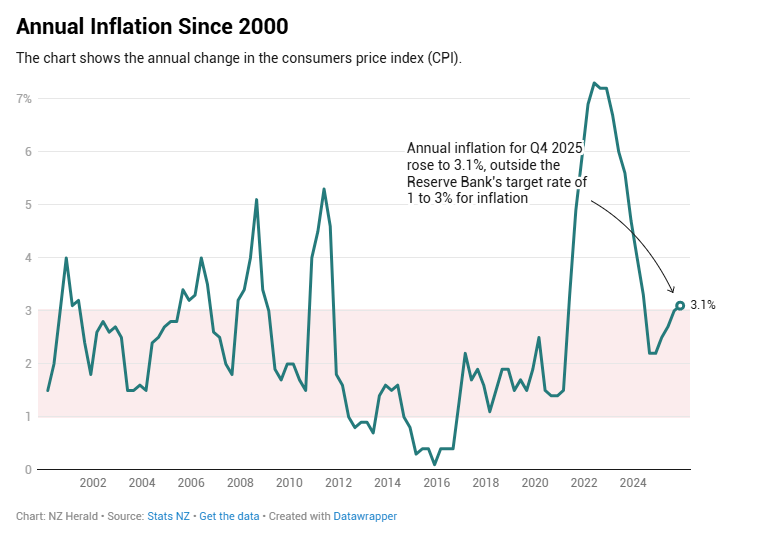
The recent rise in inflation to 3.1% has sparked concern but is expected to ease as the economy adjusts, possibly delaying interest rate hikes until later in 2026. First-home buyers remain strong, making up over 27% of market activity due to lower mortgage rates and supportive policies like KiwiSaver. Migration and service sector improvements suggest steady economic recovery, which may boost rental demand and overall housing market health.

Share Post:

  1. Inflation concerns have surfaced with a rise to 3.1% at the end of 2025, slightly above the Reserve Bank’s 1-3% target. Despite this increase, the economy still has spare capacity, so inflation is expected to ease again, possibly delaying interest rate hikes until later in 2026 rather than early 2027.
  2. First-home buyers continue to lead the property market, reaching 28.4% share in the last quarter of 2025, the highest in recent years. Favorable conditions such as lower mortgage rates, more listings, and KiwiSaver support contribute to this trend. Many first-home buyers enter the market with low deposits, helped by bank lending allowances, and some may save on housing costs compared to renting.
  3. After a long period of declining activity, the services sector showed growth in December 2025, signaling some economic strengthening beyond property markets.
  4. Migration patterns may be shifting positively, with net migration increasing slightly after a low point. This could improve rental demand, which landlords have been watching closely amid recent rent weaknesses.
  5. Mortgage activity data to be released soon will provide insight into whether bank cashback offers have triggered more switching between banks and if recent easing of loan-to-value ratio (LVR) rules has changed lending behavior. Initial reports suggest strong bank switching but only tentative movement regarding LVR relaxation.

Overall, the housing market faces mixed signals with inflation causing some caution but strong demand from first-home buyers supporting market activity, while economic and migration trends suggest potential for steady recovery and rental market improvement

Source from Oneroof: by Kelvin Davidson

Additional commentary from him can be found at https://www.oneroof.co.nz/news/finance/inflation-blow-raises-spectre-of-early-interest-rate-rise-but-how-soon-48849

The opinions and research contained in this article are provided for information purposes only, are intended to be general in nature, and do not take into account your financial situation or goals.


Stay Connected

More News & Blog

Auckland Market Update: What Local Landlords Need to Know About the Winter Property Softening

The New Zealand housing market is navigating a period of mid-year adjustment. ANZ’s latest Property Focus report explicitly highlights that Auckland is currently underperforming the national average, making it a critical time for local investors to assess their portfolios.
As your Auckland property management partner, we are closely tracking these updates. Here is a quick breakdown of what is happening across our region right now, why investors are hitting the pause button, and what it means for your local assets.

Easing Inflation Fears: Why a July Rate Hike Changes the Game for Property Borrowers

Independent economist Tony Alexander warns that an upcoming Official Cash Rate (OCR) hike is likely. While recent data shows consumer and buyer sentiment is becoming less negative, this rising economic resilience actually increases inflation risks. Consequently, borrowers face higher long-term interest rates as the Reserve Bank aims to cool down the economy

Tony Alexander: What the OCR Hold and Reserve Bank Warning Mean for Mortgage Rates

The Reserve Bank held the Official Cash Rate at 2.25% but warned that rate increases are likely to begin as early as September. Global uncertainties, especially oil-supply shocks tied to the Iran conflict, have made growth and inflation forecasts more volatile and the future path of interest rates less predictable. Given this uncertainty, medium- to long-term fixed mortgage terms (for example, three years or longer) offer better protection than repeatedly rolling short-term fixes.