


The Reserve Bank has left the Official Cash Rate at 2.25%, but signalled that rate increases are likely to begin in September and could continue over the coming years, with a projected peak around 3.3%. For property owners, managers and tenants, this means planning for higher borrowing costs ahead.
There are two main reasons the Bank paused now. First, the Bank has a recent history of tightening policy later than ideal and then over-correcting; this cycle of late action and sharp moves has made the Bank cautious. Second, global events—especially the conflict involving Iran—have reduced global oil supplies and raised uncertainties about growth and inflation. The Reserve Bank has downgraded near-term growth forecasts; it now expects weaker growth than previously predicted, which complicates rate timing.
What this means for the property market: rising fuel and import costs act like an added tax on consumers, squeezing household budgets and business margins. That pressure reduces discretionary spending and can dampen housing demand, while at the same time creating inflationary pressure from higher energy prices. The result is a more uncertain path for interest rates than in a normal cycle.
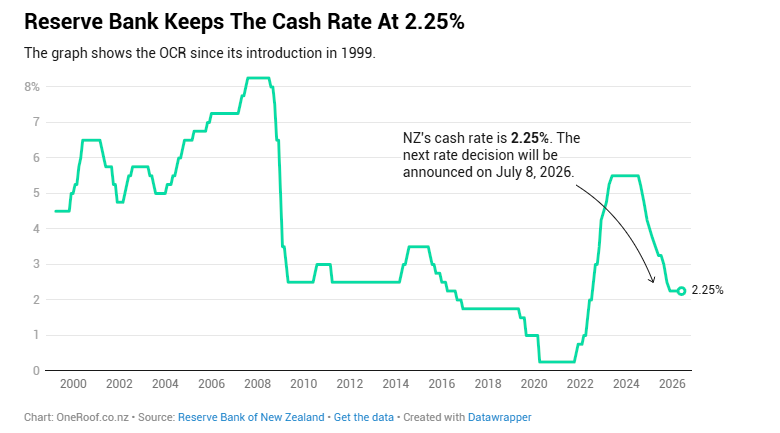
Practical guidance for mortgage holders: uncertainty increases the risk of rolling short-term fixes repeatedly. Medium- to long-term fixed rates offer more protection against volatile rate swings. While many borrowers choose two-year fixes because they are cheaper by roughly 0.2% compared with three-year terms, extending to three years provides a better hedge through the uncertain period. For those who could previously lock in attractive five-year rates, the move to shorter fixed terms has become more common as rates have risen; now, a three-year fix is a sensible middle ground to reduce rate risk.
In short, expect rate rises later this year and plan for them: review your mortgage strategy, consider extending fixed terms where feasible, and factor higher borrowing costs into cash-flow and rental pricing decisions. Good risk management now will help weather the coming period of uncertainty.
Source from Onerrof: Tony Alexander
Additional commentary from him can be found at https://www.oneroof.co.nz/news/tony-alexander-what-the-ocr-hold-and-reserve-bank-warning-mean-for-mortgage-rates-49559
The opinions and research contained in this article are provided for information purposes only, are intended to be general in nature, and do not take into account your financial situation or goals.