

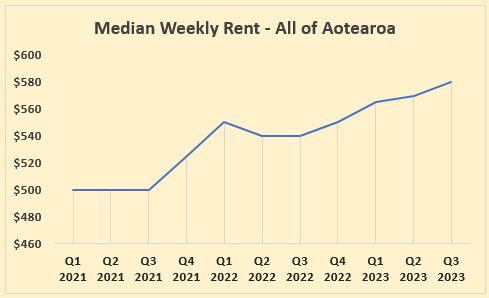
Residential rents in New Zealand increased by an average of $40 per week nationwide in the 12 months leading up to September, with Auckland experiencing a $60 per week increase. The national median rent rose from $540 per week in the third quarter of the previous year to $580 per week in the third quarter of this year, indicating a 7.4% annual increase.
Bond data from Tenancy Services is a reliable indicator of market rent trends, as most bonds are collected for newly tenanted properties, providing insight into the current market situation. Landlords and property managers often use market rents when reviewing rents for existing tenancies.
Queenstown-Lakes is the most expensive location for renting a home, with a median rent of $750 per week. This represents a $130 per week (21%) increase compared to the third quarter of the previous year. Other significant increases occurred in Taupo (up $100 per week or 22.2%), Whakatane (up $90 per week or 19.6%), and Marlborough (up $65 per week or 13.7%). Dunedin saw the smallest increase at just $7 per week (1.6%).
Surprisingly, rent increases were relatively modest in the Wellington Region, with Wellington City experiencing a mere $10 per week (1.7%) increase over the 12-month period. Lower Hutt saw a slightly higher increase of $15 per week during the same period.
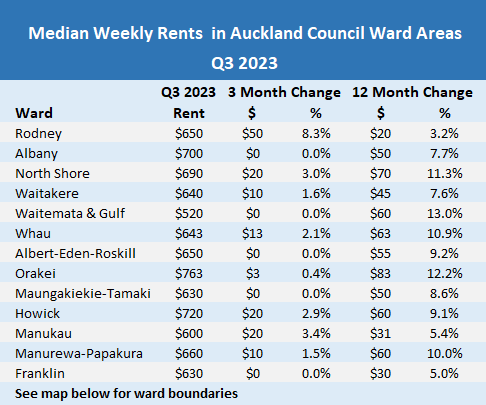
Within the Auckland region, rent increases ranged from $20 per week (3.2%) in the Rodney Ward to $83 per week (12.2%) in the Orakei Ward.
Advice and Comments for Landlords and Tenants:
- Rent increases are ongoing nationwide, particularly with significant increases in certain areas. This is crucial information for landlords and property managers when considering rent adjustments.
- Queenstown-Lakes has the highest rental prices nationwide, so landlords and tenants in this area should carefully consider the impact of rent increases.
- Areas such as Taupo, Whakatane, and Marlborough also experienced significant rent increases, warranting attention from landlords and tenants in those regions.
- While Wellington and Lower Hutt had relatively modest rent increases compared to other areas, it is still important to review the rent situation in these locations.
- Other ward areas within Auckland also experienced rent increases, highlighting the need for landlords and tenants in those areas to be vigilant about rent adjustments.
This information can be used to provide advice on rent adjustments to landlords and tenants.
Source from interest.co.nz: by Greg Ninness
Additional commentary from him can be found at https://www.interest.co.nz/property/125065/annual-rent-increases-range-7-week-dunedin-130-queenstown-lakes
The opinions and research contained in this article are provided for information purposes only, are intended to be general in nature, and do not take into account your financial situation or goals.